
by Elsa Anders Cook

LESSONS FROM THE ARCTIC TUNDRA: ON THRIVING BEYOND THE LAST MILITARY MOVE
I.
A tree can only grow where it’s planted. It can only thrive in this one place. It cannot seek out greener pastures or fresh sources of water. It is rooted in this one spot where it is not anxious or fearful. It digs deeper into the soil, reaching below the surface to find what it needs to survive.
Survival is how Annie Dillard once spoke of trees, pointing to the strange wonder of the mangroves that she has observed in the tropical waters of Florida and her visit to the Galápagos Islands. Mangrove trees have no root system dug into the earth, but “exist as floating islands.” It is an amazing thing, especially because there is so much harm that could come. Hurricanes might uproot it. Or it might crash into some rocks after being tossed and turned in a rainstorm.
Dillard likens such uprootedness to the sojourner so familiar to the Hebrew Bible. “It invokes a nomadic people’s sense of vagrancy,” she writes, “a praying people’s knowledge of estrangement, a thinking people’s intuition of sharp loss.”
II.
That vagrant estrangement tangled up in loss speaks to my family’s constant moving. The United States Army will not let us settle anywhere permanently until my husband retires. For the past ten years, after getting married and while raising tiny humans, we have picked up and moved like nomads.
Every time we move, the military insists on naming it “a permanent change of station.” We moved from Washington to New Jersey. After only one year, we packed up and headed for the prairies of Kansas. A year later, we moved north of Austin, Texas, where we remained “permanently” for three years. My husband deployed in that final year, though we didn’t know it was the last year to call that particular place home. Nor did we know that a pandemic would erupt that would complicate the 500-mile move to El Paso. My husband’s job changed every time, but Big Army has its own orders. Big Army will shuffle people around to fill positions, which sent us from El Paso to a small German city. They were gracious enough to let us stay an extra year, but after four years overseas, we had to return stateside. The moving trucks arrived again, and all of our worldly possessions were packed up again to be moved to the next duty station in Alaska.
It has only been a year since we were last uprooted. Eleven time zones separate me from the support network I had. My connection to those good people exists through a computer screen. I’ll manage. I will get by even as my roots are exposed and hungry for new soil. This will not be my destruction, though there are no mangroves here in Alaska.
Though I still feel like an island, floating in the muck, it is the end of our wandering. My husband will soon retire, and there are new questions to ask about what it might mean to grow where we are planted. Maybe even in this place on the edge of the Arctic tundra.
Here in this ground, where the frost of winter outweighs the summer sun, the scraggly plants on the tundra don’t dig down deep. Their root system hovers just below the surface where the earth has thawed. There is only a thin layer of soil above the permafrost. Shrubs and grasses on the tundra, even the bushes ripe with blueberries, claim the ground that they can. Each one holding on for dear life, praying for survival.
III.
I recently received an email from someone I’d only just met, addressed to me and another woman. We are all spiritual directors who are connected locally through our shared work. This email wasn’t about that work, but an invitation to become soul friends. I knew the term from reading John O’Donohue’s Anam Cara, which “originally referred to someone to whom you confessed, revealing the intimacies of your life.” She was asking me to become part of her root system.
I confess that I hadn’t fully believed in my survival. I was still poised for that next move, waiting for the orders to change. It was inevitable. The Army would send us rolling along again.
I didn’t know what to expect from that first meeting when I invited these women into my home, but it felt like some tendril of hope pushed through the permafrost. It wasn’t perfect. It was awkward in all of the ways that humans fumble around each other, trying to establish trust, but it left me feeling less like a mangrove tree. I wouldn’t have to be an island adrift in the Arctic.
I could, instead, find my place in the bright colors of the tundra. At this time of year, when snow dusts the mountain tops, the tundra morphs into yellow ochres, deep umbers, and burnt siennas. There are bursts of crimson red amid the darker hues, as if these plants know that time is short. Snow will come soon. The frost will not destroy them. Their web of connection is just deep enough to allow for their shared survival. It will be slow, but they will thrive right where they are planted.
Annie Dillard, “Sojourner,” in Teaching a Stone to Talk (New York: Harper Collins, 1982), 148, 150.
John O’Donohue, Anam Cara: A Book of Celtic Wisdom (New York: Harper Perennial, 1997), 12.
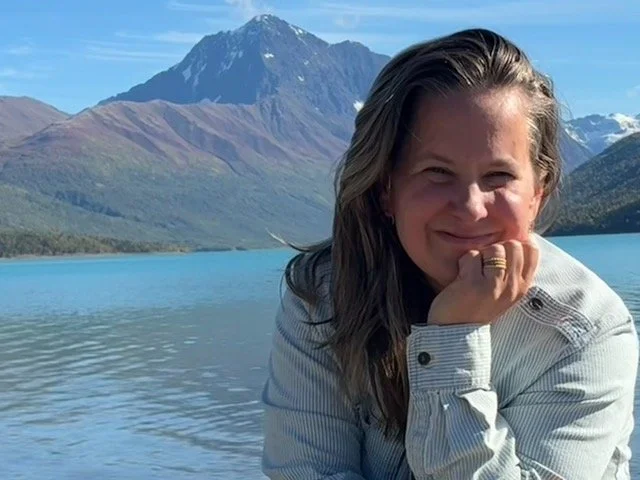
ELSA ANDERS COOK
As a spiritual director, Elsa Anders Cook is always listening. Her writing focuses on her own childhood grief. She hopes this careful attention will allow her to finally finish her first book, especially now that she, her husband, and their two little girls are finally settled on the last frontier of Alaska. Unless the military moves her family again, she can be found over on Prayer Threads.