
by Emily Curzon
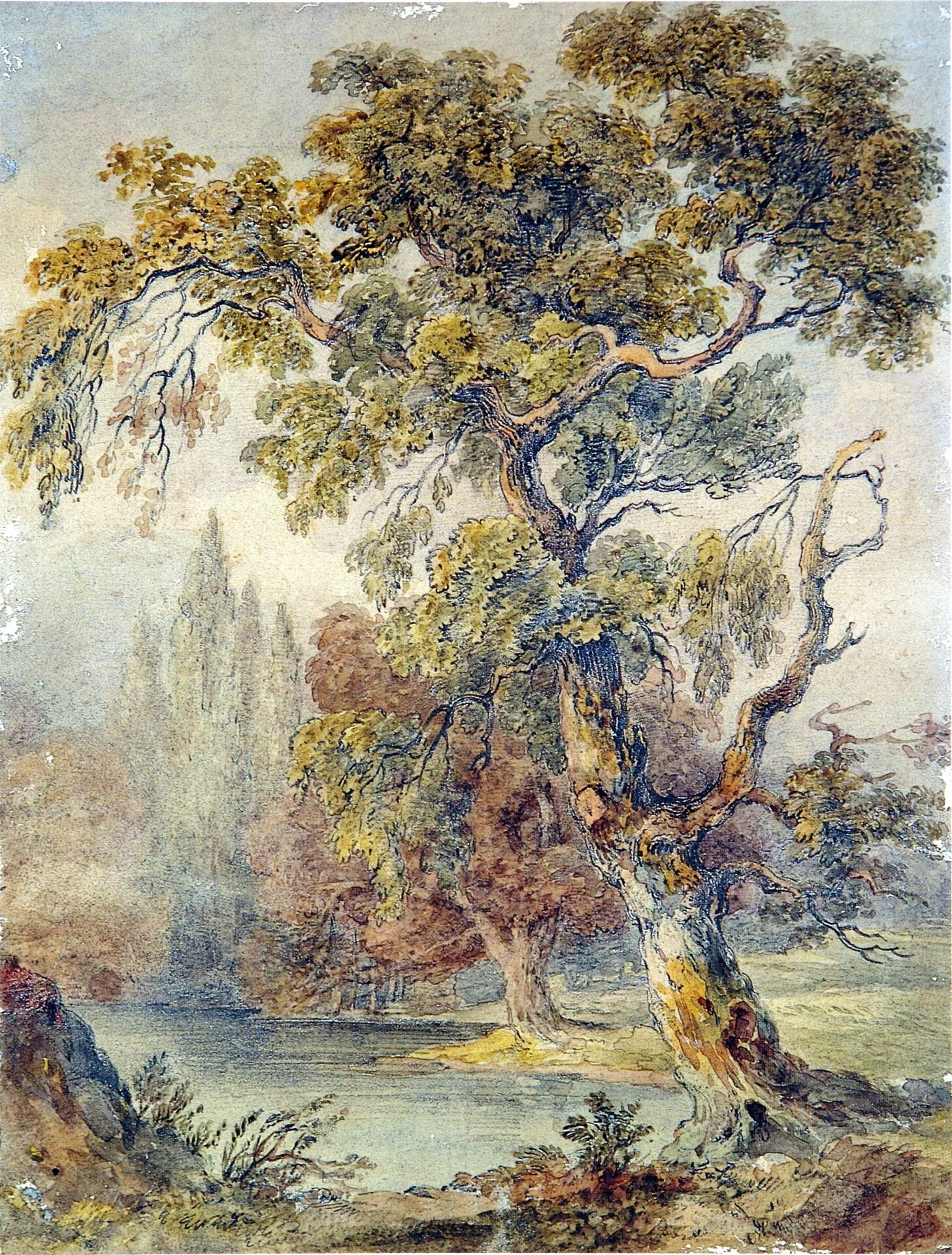
Ruskin, John. Trees and Pond. 1832. Ruskin Library, Pennsylvania.
PROXIMITY TO WATER
It has risen to a strange perfection in the warp and bending of its long growth. — Wendell Berry, “The Sycamore”
I.
There was nowhere else to go on a hot day. The pond on my grandfather’s farm boasted the only real shade far enough for kids to feel independent and close enough for earshot. We must have caught a hundred fish there every summer, maybe the same ones multiple times, but only the fish were keeping track. Grandad would tie a minnow bucket around the thick trunk of an oak tree and let it dangle in the water near the picnic table while my sister and I, together with a few rowdy cousins, traipsed around the pond’s edges as if we were the main characters in a novel, living the stuff of childhood dreams.
Among the troves of family photos that still need to be scanned, there is more than one picture of my sister and me huddled underneath that tree. In some, we’re proudly holding fish on a line with dirt on our cheeks from a day spent exploring. In others, we’re older, donning lipstick and leather boots for professionally taken family photos because we loved the spot enough to commemorate it.
The summer after she died, I went back to the tree, spoke out loud to it like an old friend, buried a few things, and left with a jar of dirt. That tree and its deep roots near the water’s edge were a balm to my greatest ache. If for no other reason than to embody a metaphor, I needed to be near it.
II.
Nearness to water holds significance beyond what we can see with our eyes. The first reflections of blue are, of course, something to behold and we catch our breath as we round the corner to them, but the real magnetism—the kind that draws turtles, cattle, wildflowers, and grieving sisters alike—comes from what we cannot see. Deep roots. The ones that have anchored an old oak tree through a drought, a storm, and a heatwave. The ones deep enough to spring a waning tree back to life after the slow death of winter.
The prophet Jeremiah names this anchoring in his poetic musings about trusting in God. Flipping the typical blessing and curse structure of Old Testament promises, he speaks first of a curse. The one who trusts in humans ends up “like a bush in the wastelands” (Jeremiah 17:6, NIV). They’re parched, alone, and blinded to good things that may come their way. Conversely, the one who trusts in God is “like a tree planted by the water” (v.8) with roots reaching out toward a stream. Miraculously, it stays green and bears fruit all the time.
The poem speaks of heat and drought as though both plants are exposed in equal measure. It’s not a matter of whether they’ll experience the intensity of the sun or the limited resource of rain. They most certainly will. The difference is that one bears fruit because of its proximity to water. Nestled close to the stream, this tree withstands the elements because it has roots deep enough to sustain it when it bends and sways, questions everything, and at last settles into the safety of its firm foundation.
III.
In college, I took a botany class taught by a professor whose enthusiasm for the plant world has stayed with me even 20 years later. One day I approached him to inquire about the cypress tree in my parents’ front yard. Its roots were destroying the surface, making it impossible to mow without damaging the blades of the mower. A cypress is meant to thrive in a bog, he explained. The roots are coming to the surface because they want the water. In other words, the tree was thirsty, and its roots instinctively sought water like its life depended on it. Spoiler alert, it did. The solution was to bury a water source deeply enough that it would draw the roots downward and allow the yard to recover.
The image of these thirsty, willing-to-travel roots has stuck with me decades later because I’ve known what it’s like to be that thirsty, to have roots and yet surrender to their search for water. In the early years of grief, my history with God is all that sustained me. I had no capacity for soul-tending work because the future held little more than the next snack for my hungry toddler. In my dark night of the soul, I remember telling God that if he had anything for me, anything to make of this pain I felt, he could just do it. In other words, do with me what you will because my participation will be minimal at best.
And like the slow budding of a first sprout, slowly and over time, my life came back in color not because the winter had passed, but because the winter had happened. I had laid myself face down at the water’s edge and let the roots find what they needed. In so many ways, I was a passive and reluctant participant in God’s redemptive work, but the water knew what to do. It blossomed something in me heartier and fiercer and brighter than I had known before death touched my life.
A decade later, I drove myself back to Grandad’s farm. It was no longer his and certainly no longer mine, but I’d driven there by the same magnetism that pulled me in as a little girl. The grass had grown tall enough that I could hardly trudge through it, so I stood at a distance and watched the water ripple in the wind. I closed my eyes and imagined it washing over me like the strange gratitude that seemed to course alongside my grief. Yet again, here at the water’s edge, God was growing in me something mercifully by his provision and my surrender: an abiding trust that I couldn’t have cultivated on my own.
This is my last time at the pond, I thought, but I’ll find more water. My roots are deeper and thirstier now because they’ve tasted the goodness, truth, and beauty of the God who held me in the elements. Now in the early morning, I rise with the sun and drink from the River of Life. I put myself in the path of its flow, and somehow in the great mystery of it all, I’m held. Find me here, anchored for all my days.

EMILY CURZON
Emily Curzon is a former therapist, turned writer and speaker. She is the voice and words behind We Have This Hope, a podcast and publication offering resources for spiritual formation, interviews with faithful and brilliant women remembering the work of God in their ordinary lives, and monthly series like So I Won’t Forget—her multi-year project to make remembering and storytelling a spiritual practice.
After a decade of work in community mental health and a lifetime of loving the church, Emily began teaching classes, leading women’s ministry, and guest preaching at her local church. She is pursuing her Master of Theological Studies at Fuller Seminary. Emily lives in Tulsa, Oklahoma, with her husband, 3 kids, and a big golden retriever.